The wide floodplain of the Mississippi River defines much of St. Louis’s subsurface, leaving large areas of the metro region underlain by soft, compressible clays and loose silts that extend tens of feet deep. When a project site in the city’s industrial corridors near the River Des Peres or along the North Riverfront sits on these weak deposits, conventional shallow footings become impractical due to excessive settlement and low bearing capacity. We approach each stone column design with a hard focus on the actual stratigraphy encountered, using vibro-replacement to transfer structural loads through the problematic zone to more competent bearing strata. Before committing to a ground improvement strategy, many engineers request a CPT test to map the continuous profile of the soft layer, which gives us the data we need to size the columns and estimate post-treatment settlement with confidence.
In St. Louis’s floodplain clays, a well-spaced stone column grid can cut primary consolidation time in half while doubling the bearing capacity of the untreated soil.
Process and scope
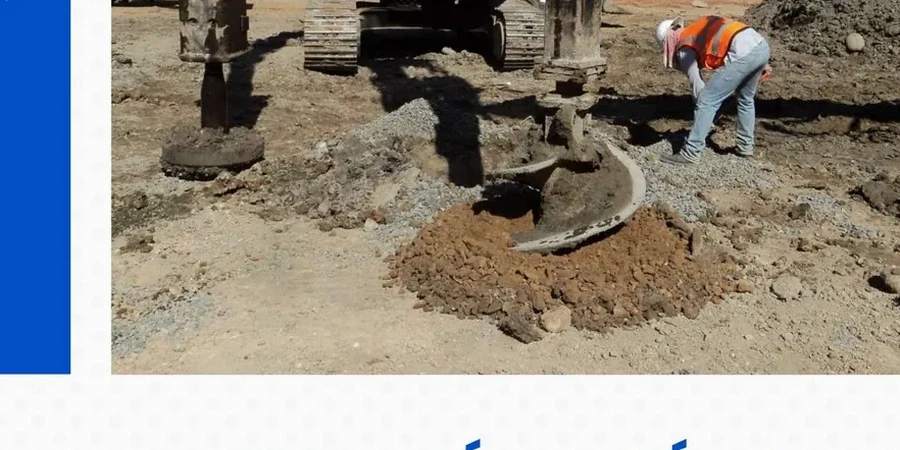
Local ground factors
The International Building Code (IBC 2021, Section 1803) requires a geotechnical investigation for every structure, but in St. Louis the risk you really need to manage is differential settlement across the transition zones where natural levee sands grade into backswamp clays. We have seen projects where a uniform building footprint straddled two distinct soil units, and the untreated half settled three times more than the adjacent competent ground. ASCE 7-22 amplifies this concern in seismic design categories D and E, because the site class can shift from D to E or even F when soft clay thickness exceeds 10 feet, driving up the spectral accelerations used in structural design. Stone columns address both problems at once: they stiffen the soft zone, reducing total and differential settlement, and they densify the surrounding soil enough to pull the site class back toward a more favorable designation. On sites within the New Madrid Seismic Zone’s area of influence, this improvement to site classification carries real structural cost savings.
Reference standards
IBC 2021, Chapter 18 (Soils and Foundations), ASCE 7-22, Chapter 20 (Site Classification Procedure), ASTM D2487 (Unified Soil Classification System for gradation specification), FHWA-NHI-16-027 (Ground Improvement Methods, Reference Manual Vol. I)
Additional services
Feasibility and Design Development
We evaluate borehole logs, CPT soundings, and lab consolidation data to determine whether stone columns are the right fix for your site, then develop column layouts, replacement ratios, and settlement projections using axisymmetric finite element models or closed-form Priebe method calculations.
Construction Monitoring and Modulus Testing
During installation we run modulus load tests directly on completed columns and perform post-treatment SPT or CPT verification to confirm that the soil between columns has densified to the target specification, giving you documented proof of improvement before structural loads go on.
Typical parameters
Questions and answers
What does stone column design cost for a typical St. Louis commercial lot?
For a standard commercial building footprint in the St. Louis area, the design, analysis, and construction-phase verification package generally falls between US$1,520 and US$5,590 depending on the number of columns, the depth of the soft layer, and the required number of modulus load tests. Sites with highly variable fill or very thick compressible clay (more than 40 feet) push toward the upper end because the analysis and verification effort increases.
How do stone columns perform in the seismic environment of the New Madrid zone?
Stone columns reduce the risk of liquefaction in loose sandy interbeds by densifying the surrounding soil during vibroflot installation, and they deliver a stiff drainage path that prevents pore pressure buildup during cyclic loading. In St. Louis, where the New Madrid Seismic Zone governs design, this can improve the site class from F to D or from E to D, which directly reduces the design spectral accelerations and can lower the structural steel and concrete quantities for the foundation and superstructure.
Can stone columns be installed right next to existing structures in the city?
Yes, but it requires careful sequencing and vibration monitoring. We specify dry bottom-feed methods in downtown St. Louis or near sensitive historic masonry to minimize vibration and avoid the water handling issues of wet top-feed. Pre- and post-construction crack surveys and seismograph monitoring at adjacent foundations are standard parts of the specification when the column grid extends within 15 feet of an existing building.