A laser level shoots across the excavation cut, picking up the faint orange chalk line where the wall stem will rise. Designing a retaining wall in St. Louis means reading the ground before a single cubic yard of concrete is placed. The city sits on a complex transition between limestone bluffs and deep alluvial deposits from the Missouri and Mississippi rivers. Bedrock depth varies wildly — from exposed ledges in the Ozark foothills west of I-270 to buried rock 60 feet down in the bottomlands near the riverfront. Our approach starts with site-specific geotechnical data: SPT drilling to log refusal depth and sample cohesion, and triaxial testing to measure drained shear strength parameters that govern wall stability. We apply active, at-rest, and passive earth pressure theories per ASCE 7-22 and IBC Chapter 18, factoring in the expansive potential of Missouri glacial till and the saturated unit weight of Mississippi River sand.
A retaining wall in St. Louis has to handle saturated Missouri River sand at the base and expansive glacial clay at the backfill — two very different soil behaviors in the same section.
Process and scope
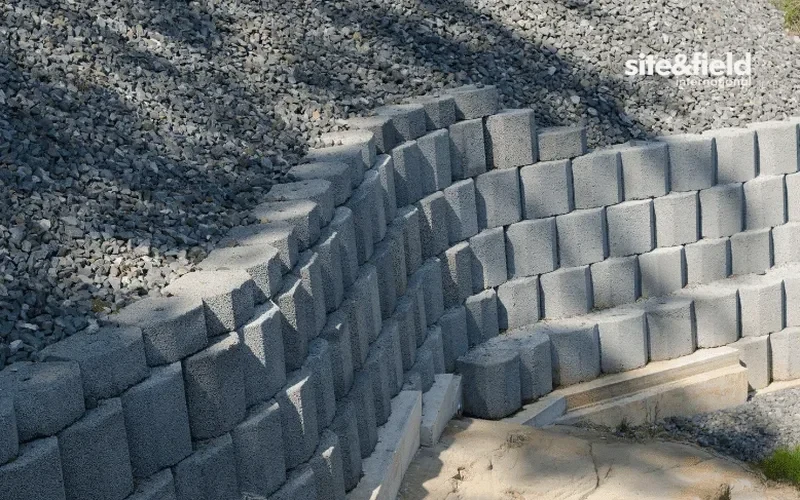
Local ground factors
A townhome developer in the Dogtown neighborhood excavated a 14-foot cut for a basement walkout and installed a segmental block wall with no geogrid and no drainage gravel. Two years later the wall tilted outward six inches at the top, cracking the patio slab above. The root cause was classic St. Louis: the backfill was on-site clay, which swelled during a wet spring and exerted pressure the unreinforced blocks could not resist. Remediation required demolition, temporary shoring, and a complete redesign with granular backfill and a subsurface drain. We see this pattern repeatedly — well-meaning contractors building walls that stand fine for one season and fail the next. A proper retaining wall design in St. Louis anticipates the worst-case groundwater condition and specifies a drainage system that remains functional for the design life of the structure, not just the warranty period.
Reference standards
ASCE 7-22 Minimum Design Loads for Buildings and Other Structures, IBC 2021 Chapter 18 (Soils and Foundations) and Chapter 16 (Structural Design), ASTM D1586 Standard Test Method for Standard Penetration Test (SPT), ASTM D2487 Unified Soil Classification System, AASHTO LRFD Bridge Design Specifications (for walls under bridge abutments)
Additional services
Gravity and Cantilever Wall Design
Reinforced concrete and masonry walls up to 20 feet retained height. We calculate stem and footing reinforcement per ACI 318, check global stability with Bishop and Spencer methods, and detail drainage that meets St. Louis County stormwater requirements.
Mechanically Stabilized Earth (MSE) and Anchored Systems
For walls exceeding 20 feet or supporting heavy surcharge, we design MSE walls with geogrid reinforcement or anchored soldier pile walls. These systems suit the deep alluvial soils along the Mississippi River industrial corridor and deliver cost-effective solutions for warehouse pad grading.
Typical parameters
Questions and answers
What does retaining wall design cost for a residential project in St. Louis?
For a typical residential retaining wall in the St. Louis metro area, design fees range from US$1,000 to US$4,630 depending on wall height, site access, and the required geotechnical investigation scope. A simple 6-foot garden wall on a flat lot falls toward the lower end. A 15-foot engineered wall with surcharge from an adjacent driveway, requiring borings and stability analysis, approaches the upper range.
Do I need a permit for a retaining wall in St. Louis City or County?
Yes. St. Louis City requires a building permit for any retaining wall over 4 feet in height measured from the bottom of the footing to the top of the wall. St. Louis County and most municipalities including Chesterfield, Florissant, and Kirkwood require engineered drawings stamped by a Missouri-licensed professional engineer for walls exceeding 4 feet or supporting a surcharge.
How do you handle the expansive clay soils common in Missouri?
Expansive clay is a primary design consideration in the St. Louis region. We specify a free-draining granular backfill zone extending at least 2 feet behind the wall stem, compacted in lifts to 95% standard Proctor density. This zone isolates the wall from swelling native clay. We also design the foundation drain to daylight or connect to a storm sewer, ensuring water never ponds behind the wall.
Can you design a retaining wall on a property line with limited access?
Absolutely. Many St. Louis City lots have zero-lot-line conditions where excavation for a traditional cantilever wall footing would encroach on the neighbor's property. In these cases we often specify an anchored wall system or a drilled shaft wall that can be constructed from within the property boundary. We coordinate with the contractor on shoring and sequencing to protect adjacent structures during construction. More info.