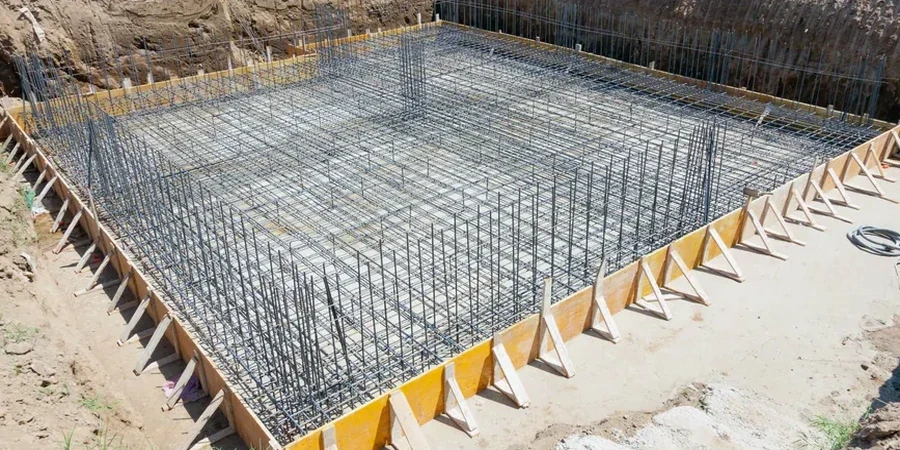
The most expensive mistake we see in St. Louis foundation engineering isn't under-designing the concrete—it's assuming uniform bearing across a site that sits on Mississippi River alluvium. When a design team places isolated footings on the layered silts and clays of the Chesterfield valley or the Illinois side floodplain, they almost always encounter differential settlement within the first five years. Raft and mat foundation design sidesteps this problem by distributing structural loads across a continuous slab, turning the entire footprint into a single bearing element. Our approach integrates subsurface data from the weathered limestone and shale residuum common to the Ozark border with a rigorous soil-structure interaction model, ensuring the mat thickness and reinforcement respond to the actual compressibility profile beneath the St. Louis metropolitan area. For projects where deep alluvial deposits are suspected, we often recommend supplementing the investigation with CPT testing to capture a continuous stratigraphic profile without the disturbance inherent in split-spoon sampling.
A properly designed raft foundation in the St. Louis alluvial plain eliminates the differential settlement risk that plagues isolated footings on variable compressible strata.
Process and scope
Local ground factors
The Mississippi River floodplain presents a stark contrast in foundation risk depending on the season: a site that appears firm in late August after six weeks of drought can become a saturated sponge by March, when the river stage rises and groundwater levels rebound. This hydrological swing directly impacts raft/mat foundation design because the undrained shear strength of the alluvial clays can drop by thirty percent between dry and wet conditions. If the geotechnical investigation is performed during a dry spell and the bearing capacity is calculated using peak strength values, the mat may be under-designed for the critical case—a fully saturated subgrade during a spring flood event. We mitigate this by always running both drained and undrained load cases, and by specifying a capillary break layer of clean, open-graded aggregate beneath the mat to prevent moisture migration into the slab. In areas within the 100-year floodplain, the finished floor elevation is set at least one foot above the base flood elevation, and the mat is designed to resist hydrostatic uplift using the buoyancy weight of the structure plus a safety factor of 1.5, as required by the St. Louis County building code.
Reference standards
IBC 2021 (Chapter 18: Soils and Foundations), ASCE 7-22 (Minimum Design Loads for Buildings), ASTM D1586 (Standard Penetration Test), ASTM D2487 (Soil Classification), ACI 318-19 (Structural Concrete for Mat Foundations)
Additional services
Geotechnical Investigation and Parameter Derivation
We execute a targeted field program—typically SPT borings with Shelby tube sampling—and then derive the design soil parameters through a laboratory campaign that includes one-dimensional consolidation, unconsolidated-undrained triaxial, and Atterberg limits. The resulting geotechnical report provides the modulus of subgrade reaction, bearing capacity, and settlement potential specific to your St. Louis site.
Finite Element Mat Design and Construction Documents
Using the soil parameters from the investigation, we build a finite element model of the mat on an elastic spring bed and run load combinations per ASCE 7. The final package includes mat thickness plans, rebar schedules, subgrade preparation details, and waterproofing specifications, ready for permit submission in the City of St. Louis or any surrounding municipality.
Typical parameters
Questions and answers
What is the typical cost range for raft/mat foundation design on a St. Louis residential project?
For a single-family home or small commercial building on a typical St. Louis County lot, the engineering fee for a complete raft/mat foundation design—including the geotechnical investigation, laboratory testing, and structural design of the mat—ranges from approximately US$920 to US$3,900, depending on the number of borings, the complexity of the soil profile, and whether the site is in a floodplain requiring uplift analysis.
How does the Mississippi River floodplain affect mat foundation design?
The floodplain introduces two critical considerations: variable soil compressibility and seasonal groundwater fluctuation. We design the mat to handle the worst-case saturated undrained shear strength, incorporate a capillary break to prevent moisture wicking, and perform a hydrostatic uplift check to ensure the structure's dead weight plus a 1.5 safety factor exceeds the buoyancy force at the base flood elevation.
Is a raft foundation better than deep piles for St. Louis alluvial soils?
It depends on the depth to competent bearing material. If rock or dense glacial till is within 30 to 40 feet, deep piles may be more economical. However, where the alluvium extends deeper—common in the Missouri River bottoms and parts of the American Bottom—a raft/mat foundation often reduces total project cost by eliminating the need for pile caps and grade beams while still controlling settlement to acceptable limits.
What soil parameters are most critical for mat foundation design?
The modulus of subgrade reaction, the drained and undrained shear strength, and the compression index from consolidation testing are the three parameters that drive the finite element model. We derive all of these from site-specific laboratory testing on undisturbed Shelby tube samples, never from presumptive values, because the variability of the St. Louis alluvium is too high to rely on published correlations.
How long does the design process take from investigation to stamped drawings?
A typical timeline is four to six weeks: one week for field drilling and sampling, two to three weeks for laboratory testing and geotechnical reporting, and one to two weeks for the structural design and drafting of the mat foundation. Expedited schedules are possible if the project is time-sensitive, but consolidation testing requires a minimum curing period that cannot be shortened.