St. Louis grew from a fur trading post on limestone bluffs into a major industrial hub, but its subsurface tells a different story below the street grid. Downtown high-rises sit on bedrock near the river, while expansion westward encountered deep sequences of glacial till and loess draped over paleozoic carbonates. Every deep excavation here intersects that transition zone where weathered shale and limestone layers create unpredictable groundwater pathways. When a project requires cuts exceeding 15 feet near the Mississippi floodplain, the difference between a routine dig and a collapse scenario depends on how well the lateral earth pressures were modeled beforehand. Our laboratory team feeds that model with direct shear and triaxial data from undisturbed Shelby tube samples, ensuring the retaining walls and bracing systems are dimensioned for St. Louis' specific stratigraphy rather than generic textbook assumptions.
Deep excavation design in St. Louis must account for the abrupt facies changes between bedrock highs and alluvial channels that can shift lateral pressures by 30% within a single block.
Process and scope
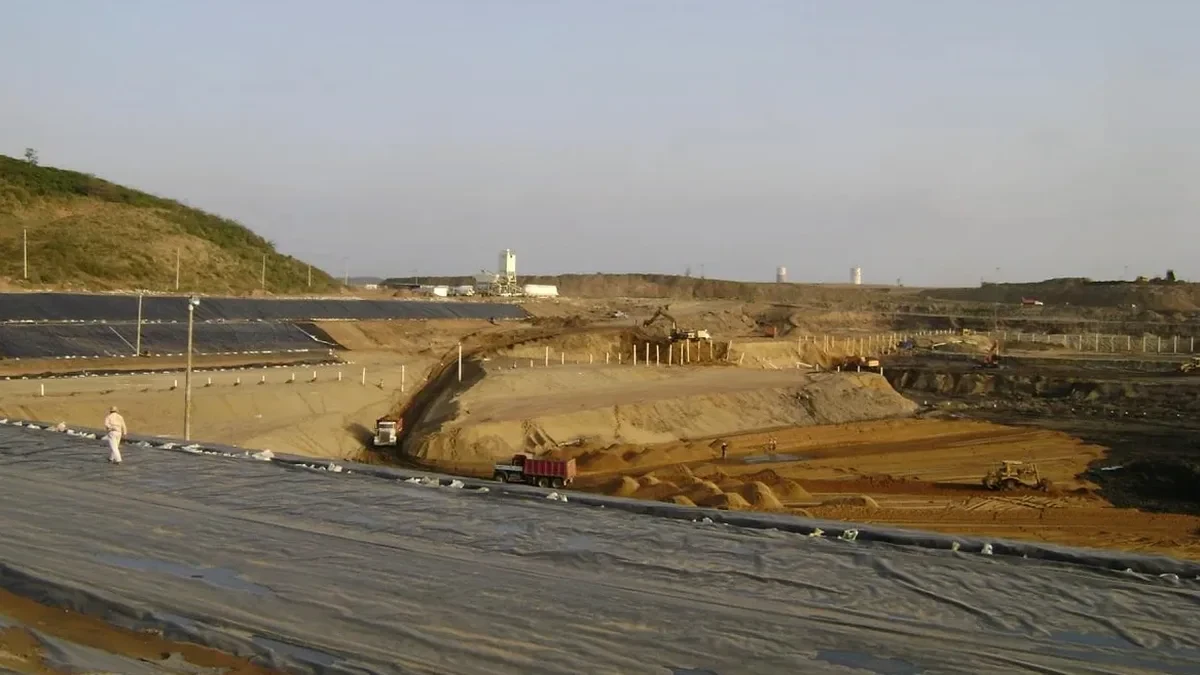
Local ground factors
St. Louis sits at approximately 466 feet above sea level, with the Mississippi River carving a floodplain that drops to nearly 380 feet along the industrial corridors of North Broadway. That 80-foot topographic relief masks an even sharper subsurface boundary where alluvial sands up to 100 feet thick pinch out against limestone bluffs. Deep excavations near this transition zone face the compounded risk of basal instability from high artesian pressures in the underlying weathered rock. A 2019 excavation on Laclede's Landing hit a pressurized sand lens at 45 feet that standard boring logs had missed, causing a partial invert blowout before rewatering stabilized the cut. Our pre-design laboratory program includes constant-head permeability tests on undisturbed specimens to map these discrete water-bearing zones, and we run staged triaxial tests that replicate the stress path of unloading as the excavation proceeds, rather than relying solely on standard compression loading.
Reference standards
ASCE 7-22 (Minimum Design Loads for Buildings and Other Structures), IBC 2024 (Chapter 18 – Soils and Foundations), ASTM D1586 (Standard Test Method for Standard Penetration Test), ASTM D2487 (Unified Soil Classification System), ASTM D7181 (Consolidated Drained Triaxial Compression Test)
Additional services
Laboratory Strength Testing for Shoring Design
Consolidated-undrained and drained triaxial tests on Shelby tube samples to determine the effective stress parameters required for accurate lateral earth pressure calculations in braced cuts.
Consolidation and Swell Analysis
One-dimensional consolidation testing to predict settlement behind excavation walls and evaluate the swell potential of the St. Louis clay layers during unloading.
Permeability and Seepage Characterization
Falling-head and constant-head permeability tests on undisturbed soil specimens to define hydraulic conductivity for dewatering system design and basal stability assessments.
Anchored Wall Interface Friction Evaluation
Direct shear testing at the soil-grout interface to deliver bond strength values for tieback anchor design in the specific alluvial or residual soil unit encountered on site.
Typical parameters
Questions and answers
What is the typical cost range for a geotechnical laboratory program supporting a deep excavation design in St. Louis?
A comprehensive laboratory testing program for deep excavation design in the St. Louis area typically ranges from US$1,900 to US$7,570, depending on the number of borings, the depth of the excavation, and the suite of tests required. A project with triaxial strength testing, consolidation analysis, and permeability characterization will be at the higher end, while a smaller scope focused on index properties and direct shear may fall at the lower end.
How do you account for the stiff clay layers encountered in the glacial till deposits west of the St. Louis metro?
The stiff glacial till in western St. Louis County exhibits overconsolidated behavior with significant cohesion. We run consolidated-undrained triaxial tests at in-situ confining pressures and track pore pressure development during shear, which allows us to separate the drained friction component from the undrained cohesion for a more precise Rankine or Coulomb pressure envelope.
What laboratory data is critical for evaluating basal heave in a deep excavation near the Mississippi River?
Basal heave analysis requires the undrained shear strength profile of the clay layers below the excavation invert, which we determine through unconsolidated-undrained triaxial testing and field vane shear correlations. We also measure the unit weight and consolidation state of those clays, because a normally consolidated zone at depth with high pore pressures presents a much higher heave risk than an overconsolidated crust.
How long does a full laboratory testing program for a deep excavation design take?
A complete program including triaxial strength tests, consolidation, and permeability typically requires 4 to 6 weeks from sample delivery. Consolidation tests on St. Louis clays often need extended load increments due to low permeability, and triaxial shear stages with pore pressure measurement cannot be accelerated without compromising the effective stress data.