The mud rotary drill rig pulls up wet gray clay from 15 feet down, and right away the field log flags a low-strength layer that changes the load strategy. In St. Louis, shallow foundation design turns on those few feet of fill and alluvium that blanket the limestone bedrock. A spread footing that works fine in Chesterfield can punch through desiccated crust in the Bottom, and a mat foundation sized for Florissant may be overkill three miles west. We correlate boring logs from spt-drilling with laboratory index tests to set bearing depth and width, then check settlement against the actual compressibility of the local loess and residual clay. The goal is a footing that transfers load without differential movement, even when groundwater rises after a wet spring along the River des Peres drainage.
Bearing capacity means little if differential settlement cracks the slab: we design footings to keep total and angular distortion within IBC serviceability limits.
Process and scope
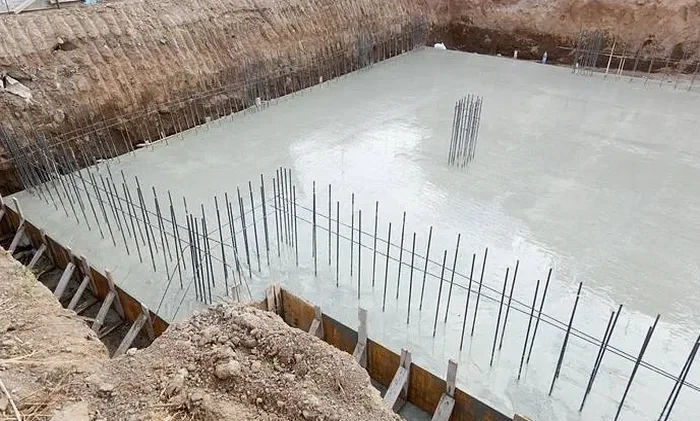
Local ground factors
At 466 feet above sea level, much of downtown St. Louis sits on a terrace just high enough to escape the 1993 flood crest, but the subgrade remembers the water. Karstic limestone under the city creates a second risk: pinnacled rock and soft clay-filled solution cavities that produce abrupt bearing changes across a single building footprint. An owner who skips a site-specific shallow foundation design risks angular distortion that racks door frames and shears partition walls within the first two wet-dry cycles. The insurance cost of repairing foundation movement five years after occupancy far exceeds the engineering fee upfront. We map rock contour with borings on a tight grid, then specify undercut depth and engineered fill where the rock surface dips more than one foot in ten horizontally. On sites within the 100-year floodplain, we add buoyancy checks and freeboard requirements per the St. Louis Metropolitan Sewer District grading code.
Reference standards
IBC 2021 Chapter 18 (Soils and Foundations), ASCE 7-22 Minimum Design Loads, ASTM D1586 Standard Test Method for SPT, ASTM D2487 Classification of Soils (USCS), Missouri Minimum Standards for Boundary Surveys (elevation datum)
Additional services
Spread Footing Design
Sizing and reinforcement for isolated and continuous footings on natural ground or engineered fill, with bearing capacity and settlement calculations sealed by a Missouri-licensed engineer.
Mat Foundation Analysis
Finite element modeling of stiffened slabs and mat foundations for sites with erratic fill or moderate swell potential, including thickened edge and interior stiffening beam layouts.
Fill Evaluation and Undercut Plans
Boring-based mapping of fill thickness across the site, recommendations for over-excavation depth, and compaction specifications for replacement fill tied to St. Louis County grading permits.
Settlement Monitoring Specifications
Pre-construction benchmarks and monitoring point layouts for projects adjacent to historic masonry or on deep alluvium where predicted settlement exceeds 0.75 inches.
Typical parameters
Questions and answers
How much does a shallow foundation design cost for a typical St. Louis residential lot?
For a single-family home on a standard city or county lot, the engineering design and sealed drawings typically run between US$1,750 and US$3,570, depending on the number of borings required and whether fill removal or mat foundation analysis is needed.
What's the minimum footing depth in St. Louis County?
The county prescribes a minimum of 30 inches below finished grade for exterior footings, but we often go deeper when fat clays are present because the active zone for shrink-swell can extend to eight feet or more. The design depth is always based on the soil profile observed in the borings, not a generic rule.
Do you need a boring for a shallow foundation, or can you use existing data?
You need site-specific borings. St. Louis soil changes sharply over short distances, especially near the river bluffs and in filled areas. Using data from a lot two blocks away can miss buried debris or a shallow rock pinnacle that alters the entire footing design.
How long does the design take once borings are complete?
We typically deliver draft foundation plans and calculations within 10 to 12 business days after receiving the lab test results. Complex sites with thick fill or karst features may add a few days for iterative settlement modeling. More info.