In St. Louis, we often see pavement failures that trace back not to the concrete mix itself but to what lies beneath — the stiff, overconsolidated glacial till and loess-derived clays that dominate the Mississippi River Valley. When these soils heave during the wet spring and shrink during the dry late-summer months, the differential movement transfers directly into the rigid slab, and that is where fatigue cracking begins. Our laboratory approach ties concrete flexural strength and modulus of rupture directly to the subgrade's resilient modulus, using data from test pits to sample the actual soil profile at the project depth rather than relying on generalized county soil surveys. This gives us a pavement thickness that accounts for the 42-inch frost depth typical of the St. Louis region and the real stiffness of the native clay beneath it, which we further characterize through Atterberg limits to quantify its shrink-swell potential before we finalize the slab design.
Rigid pavement in St. Louis lives or dies by the joint system — we design for 95°F temperature swings and a frost penetration that reaches well into the subbase.
Process and scope
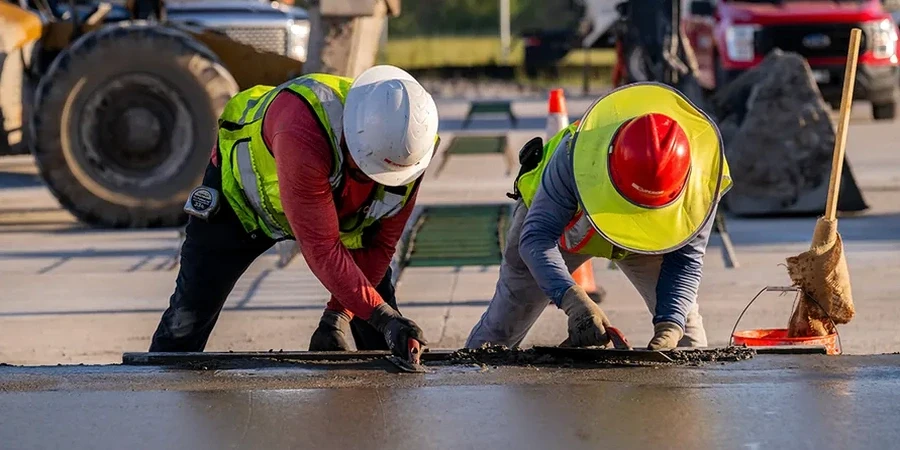
Local ground factors
St. Louis sits on a geological boundary — north of I-64 you encounter the thick, plastic loess deposits that can lose significant strength when saturated, while south of the city the residual cherty clays derived from weathered limestone create a completely different subgrade environment. The real risk in rigid pavement design here comes from underestimating the combined effect of curling stresses and traffic loading on slabs founded on moisture-sensitive soils. When the top of the slab is 30°F warmer than the bottom during a July afternoon, the corners lift, and if the subgrade has softened from spring rain infiltration through unsealed joints, that lifted corner cracks under a single heavy axle load. We see this failure mode repeatedly in warehouse parking lots and distribution centers in the Fenton and Earth City areas, where the in-situ permeability of the subgrade controls how fast water drains away from the slab interface — a parameter that standard pavement design often treats as a fixed value but that varies dramatically across the St. Louis metro.
Reference standards
ASTM C78 / C78M — Standard Test Method for Flexural Strength of Concrete (Using Simple Beam with Third-Point Loading), AASHTO Guide for Design of Pavement Structures (1993) with Missouri DOT local calibration, ASTM C666 — Standard Test Method for Resistance of Concrete to Rapid Freezing and Thawing, ASTM D1195 / D1196 — Standard Test Method for Repetitive Static Plate Load Tests of Soils and Flexible Pavement Components, ASTM C1435 — Standard Practice for Molding Roller-Compacted Concrete in Cylinder Molds Using a Vibrating Hammer
Additional services
Joint Load Transfer Analysis
We evaluate dowel bar diameter, spacing, and embedment length for the specific slab thickness and traffic spectrum of your project, using finite element modeling that accounts for the concrete's elastic modulus and the subgrade k-value measured on site rather than assumed from tables.
Roller-Compacted Concrete (RCC) Mix Design
For industrial yards and intermodal facilities in the St. Louis region, we develop RCC mix designs that achieve compaction with a Vebe time of 30–45 seconds, using local aggregates and verifying flexural strength through beam specimens compacted per ASTM C1435.
Typical parameters
Questions and answers
What is the typical rigid pavement design life for a St. Louis arterial road?
For a principal arterial in St. Louis County, we typically design rigid pavements for a 30-year service life with traffic projections converted to equivalent single axle loads (ESALs) using Missouri DOT load spectra. The slab thickness is then determined using the AASHTO 93 design equation with a reliability level of 90–95% depending on the functional classification of the roadway. We calibrate the terminal serviceability index to 2.5 for arterials and 2.0 for collector streets.
How do you account for freeze-thaw damage in the concrete mix design?
We specify a total air content of 6.0 ± 1.5% in the fresh concrete, with a spacing factor of 0.008 inches or less per ASTM C457, and select aggregates with a proven service record in Missouri DOT Class B concrete. The mix must achieve a durability factor of at least 85% when tested under ASTM C666 Procedure A (rapid freezing and thawing in water). We also require a maximum water-cementitious materials ratio of 0.45 for exterior slabs exposed to deicing chemicals.
What is the cost range for a rigid pavement design package in St. Louis?
A complete rigid pavement design package — including subgrade investigation, concrete mix development, thickness design, and joint detailing — typically ranges from approximately US$2,010 to US$6,270 depending on the project area, number of borings or test pits required, and the complexity of the traffic loading analysis. For a standard commercial parking lot of about 20,000 square feet, the design cost generally falls in the lower half of that range.
When is doweled joint reinforcement necessary versus undoweled contraction joints?
We specify doweled transverse joints when the slab thickness exceeds 8 inches or when the design traffic exceeds 5 million ESALs over the pavement life, which covers most arterial roads and industrial pavements in the St. Louis area. The dowel diameter is typically one-eighth of the slab thickness, and we detail the dowel bars with a debonding compound on one end to allow horizontal movement while maintaining vertical load transfer across the joint.