St. Louis sits on a geological puzzle. Limestone bedrock from the Mississippian period lies beneath much of the city, but in the riverfront wards and floodplain neighborhoods, you'll find 30 to 80 feet of alluvial silts and clays that behave nothing like the rock a mile west. The IBC requires a soil mechanics study for any structure classified as Risk Category II or higher, and our lab has run enough Shelby tube samples out of St. Louis boreholes to know that the difference between a routine project and a costly foundation repair often comes down to which side of the karst transition zone your site falls on. When we pull a split spoon from a Downtown West borehole and it comes up with fat clay over weathered limestone, we know to check for solution cavities before anyone pours concrete.
Karst geology doesn't announce itself until a drill rig hits a void — and by then, the foundation design has already changed.
Process and scope
Local ground factors
Compare two sites just three miles apart: one in Soulard, the other in Chesterfield. Soulard sits on 10 to 15 feet of sandy alluvium over limestone, with groundwater at 12 feet and a history of undocumented basement excavations that create hidden voids. A soil mechanics study there demands careful boring logs and cavity probing. Chesterfield lies on the edge of the Missouri River floodplain with 40-foot sequences of compressible clay that can settle half an inch under a modest footing load. The risk in Soulard is sudden collapse into a solution feature; the risk in Chesterfield is differential settlement cracking the slab over five years. Same county, same building code, completely different foundation strategy. The karst terrain underlying St. Louis County means the sinkhole hazard maps from the Missouri Geological Survey should be cross-referenced with every geotechnical report.
Reference standards
ASTM D1586 – Standard Test Method for Standard Penetration Test (SPT), ASCE 7-22 – Minimum Design Loads for Buildings and Other Structures, 2021 International Building Code (IBC), Chapter 18 – Soils and Foundations, ASTM D2487 – Classification of Soils for Engineering Purposes (USCS), ASTM D4767 – Consolidated Undrained Triaxial Compression Test
Additional services
Site Investigation and Boring Programs
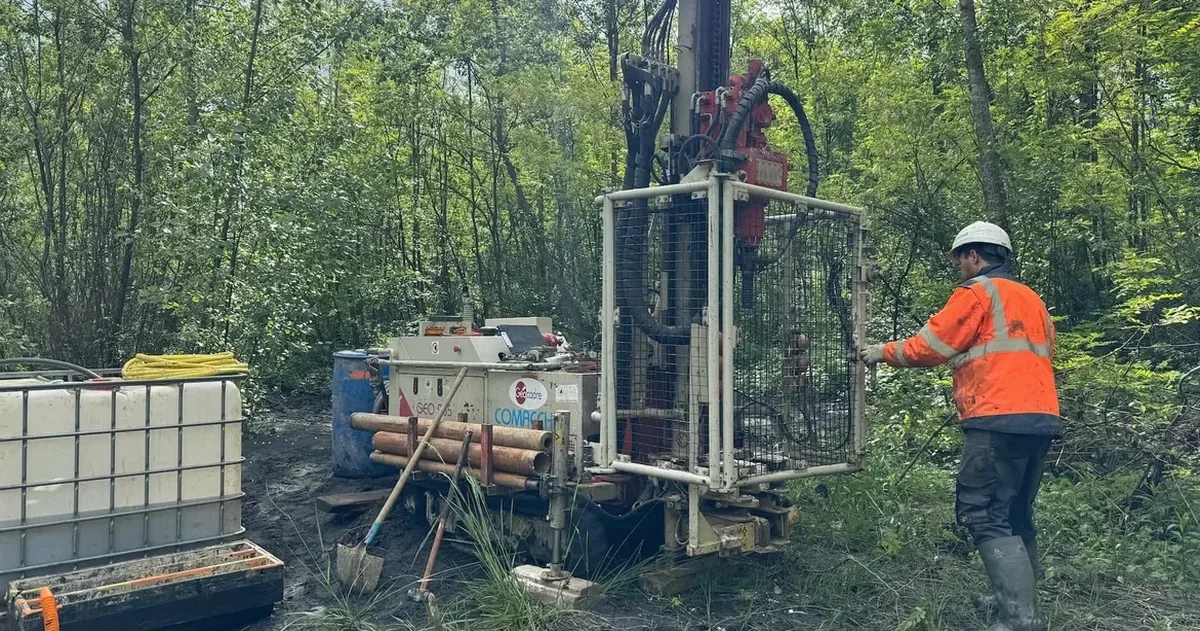
Drilling and sampling across St. Louis County and City, including hollow-stem auger and mud rotary methods through overburden into bedrock. We log stratigraphy, record groundwater, and collect undisturbed Shelby tube samples for laboratory testing.
Laboratory Testing and Engineering Analysis
Full geotechnical lab including triaxial shear, consolidation, Atterberg limits, grain size distribution, and Proctor compaction. Reports include bearing capacity calculations, settlement estimates, and foundation recommendations per IBC Chapter 18.
Typical parameters
Questions and answers
How much does a soil mechanics study cost for a single-family home lot in St. Louis?
For a typical residential lot in the St. Louis area, a soil mechanics study generally runs between US$3,440 and US$5,420. The spread depends on access for the drill rig, the number of borings required by the local building department, and whether karst probing is needed. Sites in Chesterfield or Creve Coeur with deep clay profiles may require consolidation testing that pushes toward the upper end of that range.
What depth of boring is required for a St. Louis commercial building?
Per IBC Table 1806.2 and local amendments adopted by the City of St. Louis and St. Louis County, borings for a commercial structure must extend through any compressible strata and at least 10 feet into competent bedrock, or to a depth where the added stress from the foundation is less than 10% of the existing overburden pressure. In practice, this often means 30 to 60 feet in the downtown corridor, and deeper if karst features are suspected.
Do St. Louis County and the City have different submittal requirements for geotechnical reports?
Yes. The City of St. Louis Building Division enforces Chapter 18 of the IBC with specific requirements for karst hazard documentation. St. Louis County Public Works accepts the same IBC baseline but may request additional information for sites within mapped sinkhole zones. Both jurisdictions require the report to be sealed by a Missouri-licensed professional engineer, and the soil mechanics study must include boring logs, laboratory test results, bearing capacity, and settlement analysis.