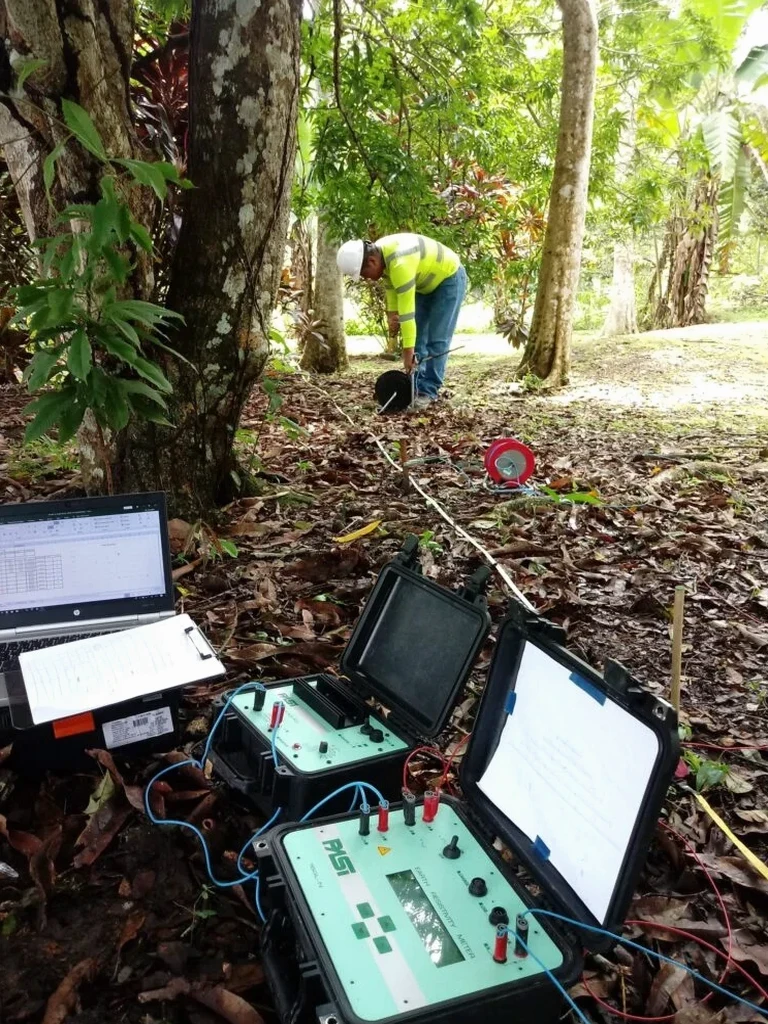
The IBC and ASTM D6431 set the framework for subsurface characterization, but in St. Louis, the geology demands more than a box-ticking exercise. The city sits on a thin veneer of loess and glacial till over Mississippian limestone, a karst-prone sequence that has shaped everything from the Gateway Arch foundations to warehouse slabs in Fenton. Buried paleochannels of the ancestral Mississippi and Meramec rivers cut across the metro area, filled with soft organic silts and loose sands that are invisible from the surface. A resistivity survey maps these contrasts before a single borehole is advanced. The electrical method responds sharply to the boundary between dry limestone and water-filled clay, making it the first tool we reach for when an owner or structural engineer needs to know where rock actually lies. We run seismic refraction in tandem when deeper bedrock rippability matters, and we cross-check anomalies with test pits in accessible areas to ground-truth the resistivity sections.
Resistivity turns a guess about buried limestone into a measured profile; in St. Louis karst, that difference is the cost of a deep foundation versus a spread footing.
Process and scope
Local ground factors
A five-story mixed-use project in the Central West End started with a dozen SPT borings that all hit refusal around 18 feet. The geologist logged competent limestone, and the preliminary foundation design called for end-bearing drilled shafts. A resistivity line run diagonally across the site painted a different picture: a low-resistivity trough snaking between the borings, consistent with a mud-filled karst conduit at 22 feet. Two targeted borings in the anomaly struck voids and soft clay where rock was assumed continuous. The shaft design was revised to socket deeper into sound rock beyond the weathered zone, and the added investigation cost was recovered before the first auger turned. In St. Louis, where the bedrock surface can drop 30 feet across a parking lot, resistivity is not a luxury add-on. It is the cheapest insurance against a change order that stops a job for three weeks while the rig waits for a redesign.
Reference standards
ASTM D6431-18, IBC 2021, ASCE 7-22, ASTM D2487-17e1
Additional services
Vertical Electrical Sounding (VES)
Schlumberger-array depth soundings at discrete locations to map bedrock topography, water table, and soil layering.
2D Resistivity Profiling
Wenner-array lines for continuous lateral imaging of karst features, abandoned mine voids, and buried channel boundaries.
Combined Geophysical Surveys
Resistivity integrated with seismic refraction, MASW, or GPR for multi-method site characterization in complex urban settings.
Drilling-Targeted Anomaly Investigation
Interpretation-driven boring placement that tests resistivity anomalies with SPT, rock coring, or test pits.
Typical parameters
Questions and answers
How much does an electrical resistivity survey cost in St. Louis?
For a typical site investigation with several VES soundings or a 2D resistivity line, the cost ranges from US$650 to US$1,070 per day of field work, depending on array length, electrode count, and access conditions.
What depth can resistivity surveys reach in Missouri karst?
With a maximum electrode spread of 200 to 300 meters, we reliably image 30 to 50 meters deep. Depth penetration depends on the resistivity contrast; in karst, the boundary between dry limestone and water-filled clay produces a strong signal.
How do you calibrate resistivity data?
The reference range for this service in St. Louis is US$650 - US$1.070. The final price depends on the project scope and volume.
Can resistivity surveys locate old mine works in St. Louis?
Yes. Air-filled mine adits appear as high-resistivity anomalies, while collapsed or flooded works show low resistivity. We run closely spaced Wenner profiles to map the lateral extent of both conditions.
How long does a survey take?
A typical 2D line of 200 meters with 48 electrodes takes one to two field days, including setup and breakdown. Interpretation and reporting add two to three days.